
Because there are no light-sensing cells in the middle of the retina where the optic nerve connects to the eye, we have a “blind spot”. Anything in the field of vision that corresponds to the fragment of light hitting this part of the retina is literally not seen. And what’s crazy is that we are totally unaware that there are gaping holes in our vision - we think we are accurately viewing the world around us, like a camera.
Try it yourself:
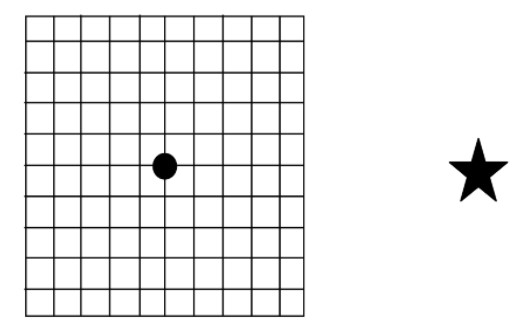
To demonstrate how our brains construct what we perceive as reality, hold the illustration at eye level, close your left eye, and stare at the circle in the middle of the grid with your right eye. Slowly move back and forth along the line of your vision until the star vanishes (about 10 to 15 inches). The star disappears because it is falling on your blind spot. Now close your right eye and stare at the star. Move back and forth until the circle in the middle of the grid vanishes. When it does notice that although the circle disappears, all the lines of the grid remain intact. This is because your brain is filling in what it thinks should be there.
Why don’t we know we have a blind spot? Because the apparatus our body uses for “sight” includes the photoshop mastery of our brain. The data received in the eyes and traveling through the optic nerves hits a few stops before ending up in the brain’s visual cortex to be perceived as “images” of our world. These areas of the brain modify the signal, so much so that some studies suggest less than 50% of what we “see” is made from the true signal received by our eyes. What is the rest? It’s a patchwork quilt of a reality the brain creates for us out of what we expect to see, what we are used to seeing, what we hope to see, even what we are afraid to see.
In his book The Holographic Universe, Michael Talbot describes being unusually transfixed by a typical No Parking sign while walking with a friend one day. It wasn’t until the friend exclaimed, “That sign is misspelled!”, that he “snapped...out of my reverie, and as I watched, the i in the word Parking quickly changed into an e.” He describes that his mind, so accustomed to seeing the sign spelled correctly, unconsciously edited out what was there and made him see what it expected to be there.
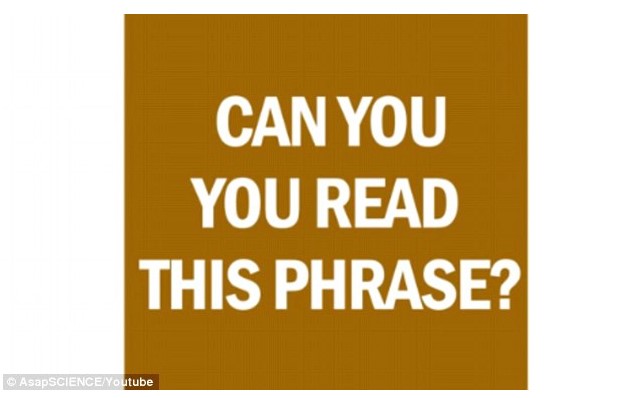
Read this sentence. Did you notice there was an extra ‘you’? The folks at AsapSCIENCE have loads of these examples demonstrating how our eyes and brains are wired for speed over accuracy. We see the quickest view that makes sense to us at the time.
Maybe this accounts for the changes we “see” in our world when there are changes in our moods, in our “history”, in our hopes and fears, even our resistance for whatever reason to what may be in plain sight right in front of us.
Maybe the awareness that we all share this limitation could let us loosen the grip we have on our conviction that what we see is “the truth”, and allow us more comfort in relying on other parts of ourselves - our logic, our hearts, our “gut instinct”, and our “mirrors”- the people sharing our worlds. This awareness might open us up to taking in more of the whole, and watching with a higher part of ourselves to “see” a new reality.